Spring 2024
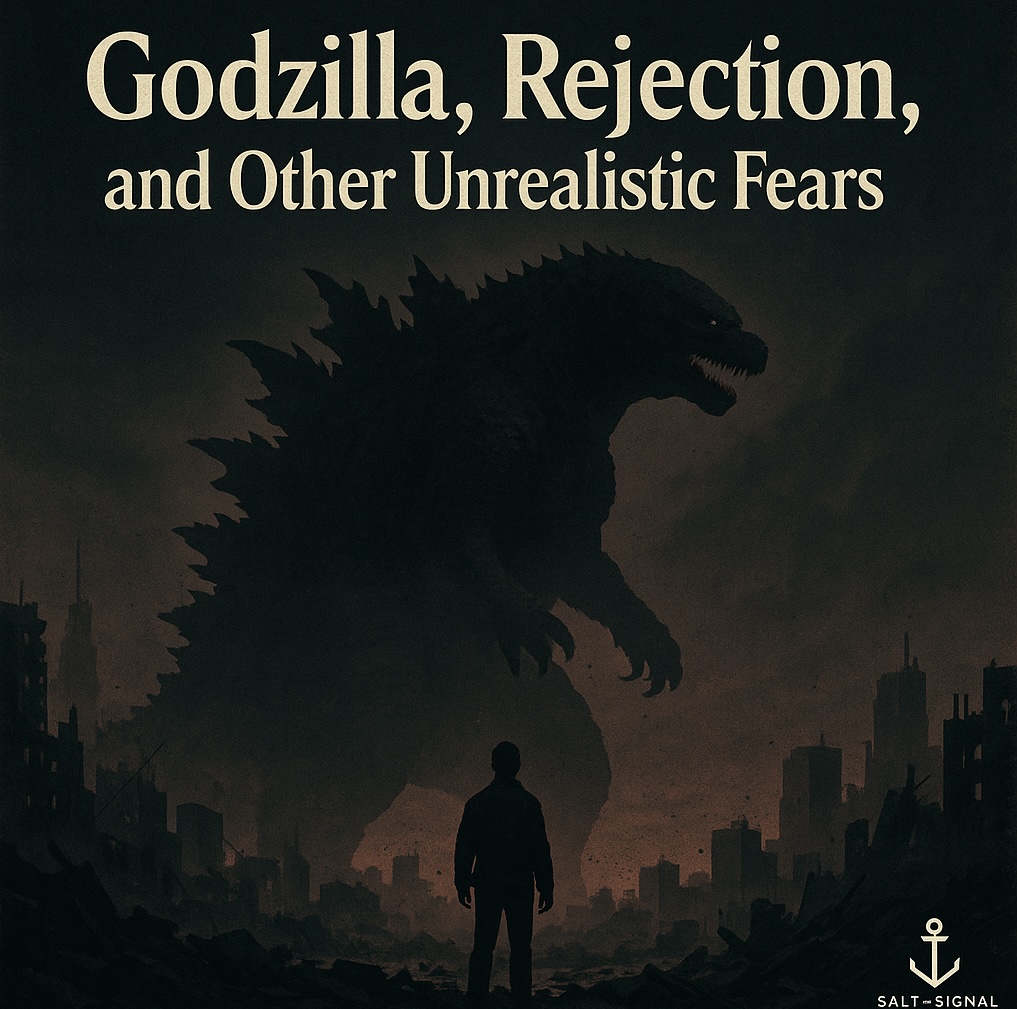
Sunday matinees at the movie theatre — or any theatre, for that matter — have always been a favorite showing of mine. Due to recent world events (a global pandemic, with ongoing fallout — in case your rock dwelling doesn’t have internet) and having spent most of that time rotating in and out of doctor’s offices and hospitals, I hadn’t seen a movie in a long time.
Today, a few friends were taking their Godzilla-loving 7-year-old son to see the newest iteration of the franchise. They invited me to tag along, so I did. As we made our way to the local silver screen, the mental image that came to mind was a man in a tarnished Barney the Dinosaur suit, trampling over a tiny balsa wood reproduction of 1940s Tokyo. The film we saw was much better made than my imagination (obviously), but I didn’t expect this fantasy story to connect so deeply with the real feelings of dread, hopelessness, foreboding, and overall loss that come when disaster strikes — not just once, but over and over again.
The scene is set with the backdrop of a recently atomic-bomb-ravaged Tokyo, and a few of the souls trying to make a life in the shantytown that was once their great capital city. The main character spends the film questioning why he is still alive, why he keeps dodging death unlike his fallen brothers, and is haunted by self-imposed demons. He’s taunted by the idea that he alone was responsible for the deaths of his fellow soldiers, all while ignoring the elephant — or in this case, gigantic reptilian — in the proverbial room. He almost lets this personal war not only destroy him but push away dear loved ones out of fear that knowing him will also be their downfall.
As I watched, I started to become distracted by emotions and memories from my own past. There were some pretty dark days. Days when I felt like I was floating between a thin veil, and the idea of living under the conditions my body was in became hard to stomach. This vicious cycle of long Crohn’s flares, chronic pain, surgeries, hospital visits — was it ever going to end?
When told my only option was to have a diverted bowel for a while to allow my rectum to heal, I resigned to the fact that maybe the obstacle is the way. I needed relief from what daily life had become by September 2021.
Having an ostomy bag was supposed to be temporary, and I can gut out almost anything difficult if there’s an end date. The first year of having a loop ileostomy started off pretty well. I had excellent support from the team at Northwestern Medicine and Duly Health. I was in much less pain, but did not fully respect how changed my body was.
By December of 2022, I had deteriorated significantly and was battling suicidal ideation daily. Life had become overshadowed by this disease and the care it took to keep going.
I had been referred to University of Chicago in October 2021 and decided to have them completely take over my care. It seemed like the natural decision — the place I should be. Dr. David Rubin and his team are the gastroenterologists to see for IBD. As their ads like to say, they’re tough on Crohn’s disease and “At the Forefront” of modern medical care. I was being cared for by Dr. Noa Cleveland and Dr. Kinga Olortegui — both undoubtedly credentialed and excellent at what they do.
My last months of battling Crohn’s weren’t focused on the best care for my body. Due to apparent concerns from Dr. Olortegui, attention shifted away from the confirmed issues with my ostomy — issues that had landed me in the ER multiple times — and instead focused on weight loss and a strong push toward gastric sleeve surgery. A permanent modification to my gut, beyond the already difficult plan of a total proctocolectomy with end ileostomy.
From September 2022 through February 2023, I was out of work on medical leave, tethered to a surgeon who refused to acknowledge the actual issues at hand or consider the patient in front of her. It became a game of numbers. I weighed myself before every appointment, pushing through painful workouts because my doctor kept minimizing the pain I was in. She claimed it was unrelated to the ostomy. I couldn’t get my weight down fast enough.
I was at the point of nightly loading my .357 magnum revolver, laying it on the nightstand, and leaving it there — waiting for the moment I might finally have enough conviction to end it. I went from believing I was in the best hands to experiencing neglect and dismissal. Even after expressing my concerns to Dr.Cleveland, there was no change.
Dr. Olortegui explicitly stated my case was non-emergency — despite the unpredictable behavior of my ostomy and four trips to the ER, two of which were directly to UChicago.
There was no acknowledgment of this ongoing issue until my last ER trip to UChicago in January 2023 — just 36 hours before my surgery date of 02/01/2023 — when, after 16 hours at home trying to calm my abdomen, I finally came in defeated but hopeful that this time, the doctors would see it for what it was. The imaging was undeniable.
From November 2022 through January 2023, Dr. Cleveland and Dr. Olortegui had differing views on my imaging. Both were coaching me — separately — through this. Dr. Cleveland saw a major issue and was concerned enough to keep me off work. She also told me that the colorectal surgery team at UChicago has a pattern of denying the severity of cases like mine. Meanwhile, Dr. Olortegui was rarely available, unresponsive to MyChart messages, and still telling me over the phone to keep focusing on my weight, insisting that was the real problem.
Now, in 2024, those events still haven’t settled into concrete shape in my mind. I sometimes wake up swiping at invisible hands, ripping away chords and IVs that aren’t there. Sleep had become the enemy — dreams a place of reminders, ghosts, and buried emotions I tried to keep under wraps.
But something flipped in my mind. A switch. And it’s offered some reprieve. The acknowledgment that yes— it really did happen. It might not matter to the medical professionals involved. But that doesn’t make it any less real. Or any less painful.
The motivation to speak out has returned. Not for revenge. Not to stay bitter. But to do what I can so my story doesn’t become someone else’s.
Godzilla, to me, is a writer’s way of dealing with unfathomable pain. A way to give shape to the destruction.To say: this monster may be out of our control, but we can name it. Maybe even learn from it. Godzilla was born of catastrophe. A symbol of the devastation wrought by war and weaponry. A dark mirror.
And isn’t that how fear works? The unknown becomes a monster. Pain conditions you to expect more pain.
You start to catastrophize. You prep for the fall before it comes. And the fear becomes so loud, you can’t hear anything else. Can’t see past the threat. It becomes all you know.
Writing has become a way to navigate that dark. To name the monsters. To heal. And if you saw anything of yourself in these words, I hope it helps you too.
The hardest part? Forgiving myself for trusting so deeply. For thinking I had found more than doctors — that I’d found allies. Even friends. People I looked to for hope. People I now wish I could sit down with and simply ask: what happened?
My Godzilla was Crohn’s. But the real war has been fought in the quiet places of my mind.
Reprieve has come in admitting the truth: I was never in power as the patient. I couldn’t have seen what was coming. I wish I had. But I didn’t. And that doesn’t make me foolish. Just human. -CT
 Salt and Signal Studios
Leave a comment